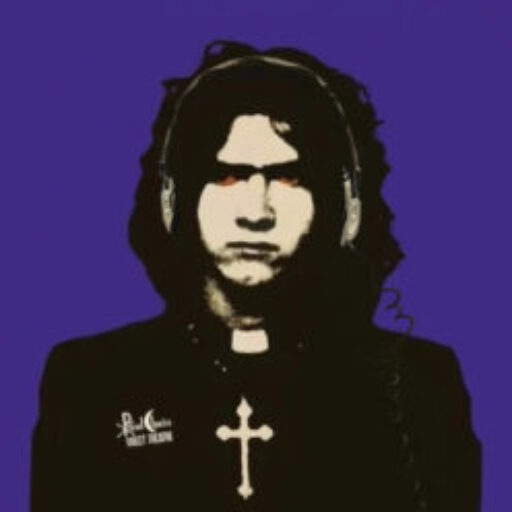
Daughters of Darkness: ALUCARDA (1977)
Doom Cinema exists because certain films and certain music share the same blood. They were built in different rooms, by different hands, but they arrive at the same place: enclosed spaces, obsessive bonds, institutions rotting from within, the body as a site of punishment and desire. Alucarda is one of those films, and its roots run deep: Le Fanu’s 1872 Carmilla, Stoker’s 1897 Dracula, de Sade’s Justine from 1791, Goya painting his black visions onto the walls of a house nobody else was meant to enter. Director J.L Moctezuma drew from all of it, fed it through the Panic Movement, and came out the other side with something that belongs at the center of everything doom has ever been about.

Juan López Moctezuma came to cinema by way of theatre, radio, and advertising, and through his long collaboration with Alejandro Jodorowsky, the Chilean-French filmmaker, playwright, and comics writer who co-founded the Panic Movement in Paris in 1962 alongside playwright Fernando Arrabal and artist Roland Topor. The movement took its name from the god Pan and drew directly from Antonin Artaud‘s Theatre of Cruelty, the theory Artaud had laid out in his 1938 collection The Theatre and Its Double: a theatre of total sensory assault, one that bypasses rational thought entirely and hits the audience the way a plague hits a body, spreading through the nervous system before the mind has time to defend itself. Artaud wanted transformation, not entertainment, and he wanted it delivered through lighting, sound, movement, and screaming from all directions simultaneously.
Jodorowsky took that call and ran with it. Fando y Lis (1968) was packed with content designed to detonate in Catholic Mexico: graphic nudity, blasphemy, a mockery of the Eucharist, a Pope played by a woman in a fake beard. It spat directly in the eye of conservative Mexican religious culture, and at its premiere at the Acapulco Film Festival, prominent Mexican director Emilio Fernández publicly vowed to kill Jodorowsky. The government banned the film shortly after. El Topo (1970), the acid western that inaugurated the midnight movie phenomenon, was championed by John Lennon. The Holy Mountain (1973), funded through Lennon and Allen Klein, was an alchemical phantasmagoria built on tarot symbolism and ritualistic excess. Moctezuma produced both Fando y Lis and El Topo, absorbing those instincts at close range. By the time he began shooting Alucarda, la hija de las tinieblas, “the daughter of darkness,” in August 1975, they had calcified into something entirely his own.
The film opens in 1850. A woman named Lucy Westenra gives birth in a derelict colonial palace and begs a hunchbacked gypsy to carry her infant daughter to a nearby convent, fearing the devil will claim her. Lucy dies of complications from childbirth. The gypsy runs. The infant grows up inside stone walls. Her name is lifted directly from Bram Stoker‘s 1897 novel: Lucy Westenra is Dracula’s first English victim, the one who dies and rises as a vampire. Moctezuma borrows it with intention, and then casts Tina Romero in the role, the same actress who plays Alucarda herself fifteen years later. Mother and daughter, one face.
The name Alucarda is Dracula reversed. Moctezuma described his protagonist as a female vampire in all attributes except blood-drinking, drawing on powers Stoker catalogued that rarely make it to the screen. The deeper source is Le Fanu‘s 1872 novella Carmilla, which predates Stoker’s Dracula by twenty-five years and gave vampire fiction many of its defining conventions before Stoker formalized them. Le Fanu’s story follows Laura, a young woman living in an isolated castle in Styria, Austria, with her widowed father. A carriage crashes near the castle, and its passenger, the beautiful and mysterious Carmilla, is left in Laura’s care. Their bond deepens quickly, charged with affection, obsession, and predation simultaneously.
Carmilla is prone to fits of melancholy, appears only late in the day, and speaks of dreams that eerily mirror Laura’s own. Le Fanu departs from the negative idea of female parasitism by depicting a mutual and irresistible connection between Carmilla and Laura, with Laura herself experiencing both attraction and repulsion toward her guest. Moctezuma takes this architecture and transplants it inside a Mexican convent, replacing the isolated castle with stone walls and crucifixes, and trading Le Fanu’s slow atmospheric dread for something rawer and more physical. The bond between Alucarda and her newly-found “sister” Justine runs on the same current: irresistible, consuming, and aimed from the beginning at destruction.

Fifteen years after the prologue, Justine (Susana Kamini) arrives at the convent as a new orphan. Alucarda finds her immediately and calls her sister. As a nod to Jodorowsky, Moctezuma employed many surreal touches: imaginative set design, costumes, and characters depicted in broad strokes. The convent at the film’s center bears no resemblance to anything rooted in reality, with its primeval appearance seemingly carved out of rock. Multiple tiered Christs hang from the ceiling.
The nuns are clothed in what appears to be torn, bloodied bandages, layered and flowing, each habit carrying its own tinges of dirt and red, with a heavy concentration of blood at the front suggesting the nuns have wiped their hands there, or bled directly onto the fabric.
The color coding runs through the entire film with the precision of a visual argument: Alucarda draped in funerary black, the gypsies outside the convent walls dressed in greens and bright colors, their costumes marking freedom as something dangerous and alive against the wound-palette of the institution. The convent is grim, confined, and dirty, while the outside shots are gorgeous and alive with vibrant color. The production design mirrors the film’s central pressure: repression against the world beyond the walls.
Romero carries all of this without buckling. She moves from vulnerability to seduction to destruction in the space of a single scene, and the combination refuses to resolve into either victim or predator. Kamini plays Justine as the luminous innocent pulled irresistibly toward ruin, the other half of a dynamic Le Fanu would have recognized instantly.
Claudio Brook plays both Dr. Oszek, the rationalist physician, and the hunchbacked gypsy who set everything in motion in the prologue: the same body inhabiting two sides of the same collapsed argument, the man of science and the agent of the supernatural, neither one triumphant.
The film belongs to the tradition of anticlerical horror that Ken Russell pushed into English cinema with The Devils in 1971. But where Russell weaponized historical specificity and operatic production design, Moctezuma builds an ahistorical fever world. The period setting exists at one remove. The film’s centerpiece is an exorcism conducted with total institutional conviction, observed by a rationalist who can only stand and call it barbaric. Moctezuma gives no one the satisfaction of being right.
De Sade runs through the film’s edges. The girls are named Justine and Alucarda, mapping directly onto Justine, ou les Malheurs de la Vertu, “Justine, or the Misfortunes of Virtue,” the 1791 novel de Sade wrote anonymously after his release from prison, which he described in a letter to his lawyer as capable of corrupting the devil. De Sade’s Justine is a young girl whose steadfast faith and naive trust mark her from the outset for suffering and exploitation. The novel’s central argument is that God is indifferent, wickedness is the engine of human activity, and the misfortunes suffered by the heroine result from her failure to recognize these truths.
At one point Justine seeks shelter in a convent and is abused by the monks inside it. De Sade used her as a vessel for a single, relentless demonstration: virtue is not rewarded, it is punished, and the more devout and innocent you are, the more completely the world destroys you. Moctezuma takes that structure and runs it through a Mexican convent in 1850. His Justine arrives innocent, trusting, and devout, and is destroyed by the very walls she runs toward for safety. After failing to save the girls, the nuns flog one another in mass acts of atonement. Martyrdom as permanent condition.
The film premiered at the Paris International Festival of Fantastic Film in March 1977. In Mexico, it screened for approximately two weeks in a censored version and was poorly received. Internationally, it circulated on home video as Sisters of Satan and Innocents from Hell, gathering a cult following through genre publications including Fangoria. The Mondo Macabro DVD release in 2002 features Guillermo del Toro, who has spoken at length about his admiration for Moctezuma’s work. Claudio Brook later appeared in del Toro’s Cronos.
Moctezuma died in 1995. He directed five features across his career. Alucarda is the one that survived him at full force, and it belongs to a specific tradition of art made entirely outside institutional sanction, driven by obsession rather than commission. Francisco Goya painted his black paintings directly onto the walls of his house outside Madrid between 1819 and 1823: deaf, isolated, commissioned by nobody, making work that had nowhere else to go: Saturn devouring his son, congregations of hollow faces, a dog’s head barely cresting above a yellow void. He had watched the Spanish Inquisition, the Napoleonic invasion, and the restoration of absolute monarchy, and the black paintings are what that accumulation looks like when it has nowhere left to go.
William Blake was working from the same premise on the other side of Europe, engraving his illuminated plates by hand in a rented room in Lambeth, self-publishing books that nobody bought, building a private mythology in which organized religion and institutional law were the true forces of evil and human desire the only legitimate god. Both men arrived at the same conclusion through different routes: that the Church, the State, and every structure that claims to protect the innocent will, given the opportunity, consume them instead.
Moctezuma absorbed that conclusion from inside the Panic Movement itself. Arrabal had lived it literally: in 1967 he returned briefly to Franco’s Spain and wrote a dedication in one of his books critical of the regime, was arrested, and faced a blasphemy charge before Samuel Beckett, Eugène Ionesco, and Arthur Miller intervened and secured his release. Topor, the third co-founder of the movement, was a Polish-Jewish child who had spent the early years of his life in hiding from the Gestapo in Savoy; he grew into an artist whose pen-and-ink drawings, dense with crosshatching and dark humor, placed human bodies in situations of quiet institutional horror, the mundane and the grotesque pressed so close together they became indistinguishable. Alucarda is where all of that arrives.
*